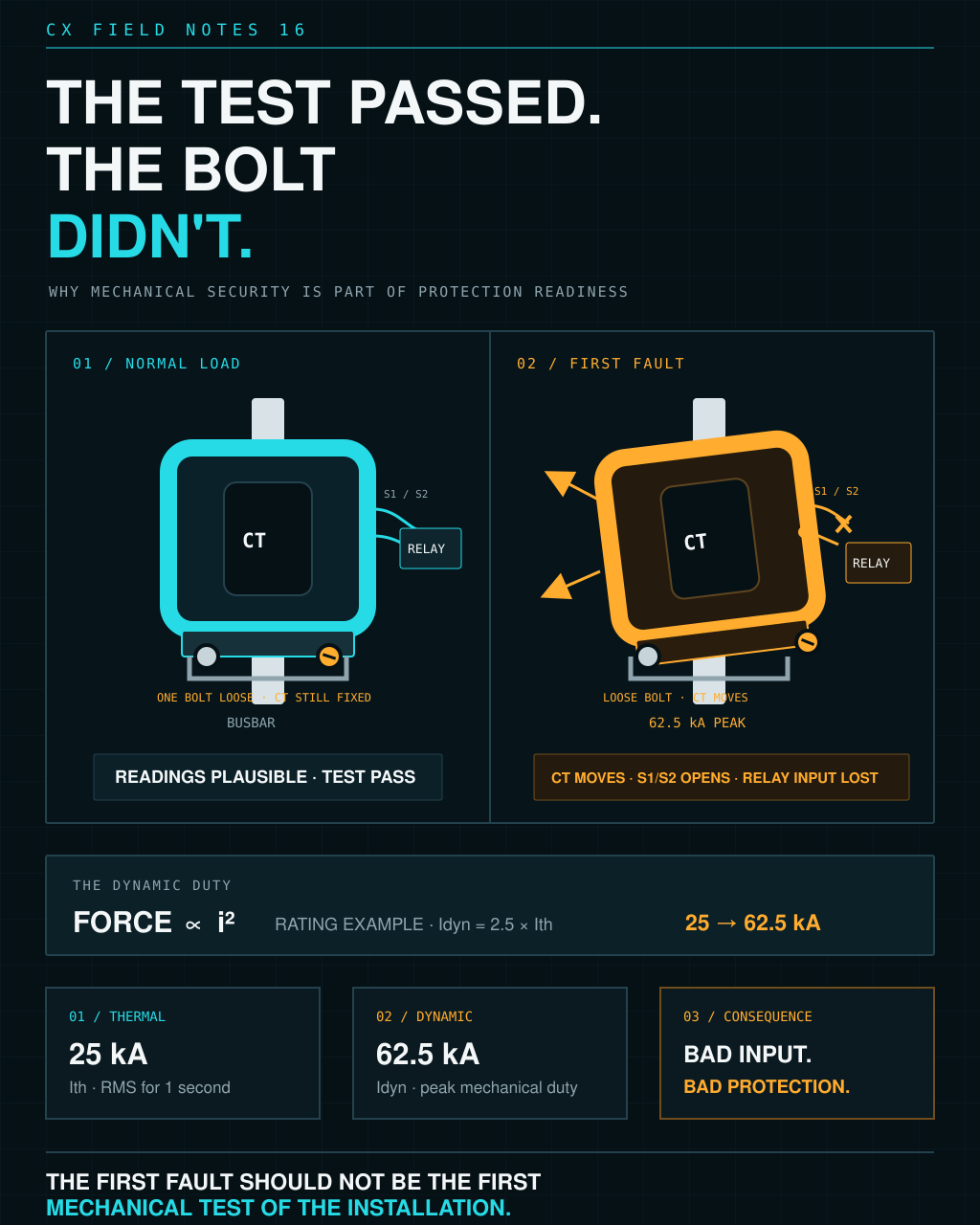
A loose CT mounting bolt is often recorded as a minor mechanical snag because the transformer remains in position, the relay displays plausible current and the electrical tests may still pass. But the mounting hardware is part of the installed equipment configuration. It maintains the CT's position, clearances and support for its secondary leads under transport, vibration and fault duty. Normal-load readings do not demonstrate that the assembly is mechanically secure for a high-current event.
For fixed conductor geometry, electromagnetic force rises approximately with the square of current: five times the current can mean roughly twenty-five times the force. A CT rated at 25 kA short-time thermal current for 1 second may have a standard rated dynamic current of 62.5 kA peak. If a loose fixing permits movement at that first peak, the CT body, insulation, secondary leads or terminals can be stressed. One phase may become intermittent or open, producing a missing or distorted protection input, false residual or differential current, delayed operation, unwanted tripping or failure to trip. An open CT secondary under primary current can also develop hazardous voltage.
With the equipment isolated and made safe, verify the actual CT arrangement against the approved drawing and manufacturer instructions: type, ratio, class, polarity, orientation, every mounting bolt, bolt grade, washers, locking method, OEM torque, alignment, clearances, lead support, secondary terminals, shorting links and the specified single-point earth. Not every CT uses the same fixing arrangement, so a generic torque table or an aligned paint mark is not a substitute for the equipment-specific requirement.
Make CT mechanical security part of the energisation-readiness evidence, not a cosmetic punch-list check. A missing or loose mounting component remains open until it is installed and torqued to the OEM requirement. If the CT or its wiring has moved, define the affected scope and repeat the relevant visual, terminal, ratio, polarity, secondary-loop, earthing, relay-current, primary-injection and functional-trip checks as justified. Record the rectification, torque evidence and retest results. A successful low-current electrical test does not close an identified mechanical defect.
05 · FIELD TAKEAWAYA CT can pass every commissioning test point and still be mechanically unready for the first fault. Protection depends on the sensor remaining fixed, intact and connected when the fault current arrives.
This note describes a recurring industry pattern using combined and simplified examples. It does not represent a particular client or project.