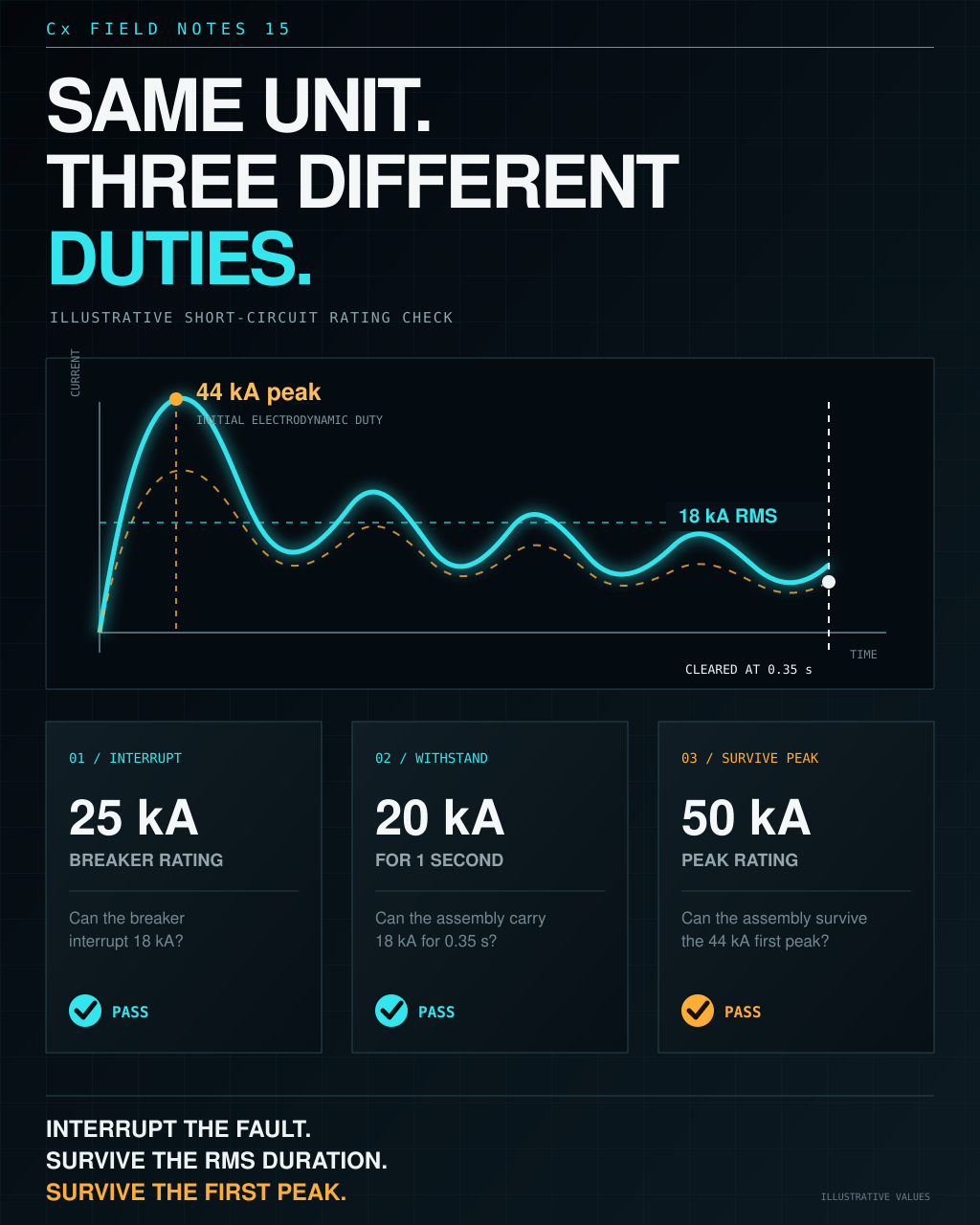
A switchgear schedule lists a 25 kA rated short-circuit breaking current for the circuit breaker and a 20 kA for 1 second short-time withstand current for the assembly. Because both values are expressed in kA, they are treated as interchangeable or checked against the fault study as though they prove the same capability. They do not. Breaking current is the prospective short-circuit current the breaker is rated to interrupt under its specified conditions. Short-time withstand current is the RMS current the closed switchgear main circuit can carry for a stated duration. Rated peak withstand current is a separate check of the initial electrodynamic duty.
Matching only the breaker rating can leave the busbars, conductors, CT primary circuits, joints and connections unverified for the time the fault remains present. Matching only the short-time rating does not prove that the breaker can interrupt the fault. Ignoring peak current can miss the highest mechanical force, while ignoring the actual protection and breaker operating time can make the stated duration meaningless. The same unit does not mean the same duty.
Take an illustrative system with 18 kA prospective symmetrical RMS fault current, 44 kA calculated peak current and 0.35 second total clearing time. Check each value independently: 18 kA against the breaker’s 25 kA rated breaking current; 18 kA for 0.35 seconds against the assembly’s 20 kA for 1 second short-time withstand rating; and 44 kA peak against its 50 kA rated peak withstand current. The numerical margins are visible, but the conclusion remains conditional on the applicable voltage, service conditions, protection study, approved settings and manufacturer ratings.
Add a short-circuit rating cross-check to the energisation readiness pack. Record the prospective symmetrical RMS current, calculated peak current, total clearing time including relay and breaker operation, breaker breaking rating, assembly short-time withstand rating with duration, and assembly peak withstand rating. Reference the fault study, approved protection settings, equipment datasheet and nameplate, then state PASS or HOLD against each comparison separately.
05 · FIELD TAKEAWAYThe breaker must interrupt the fault. The switchgear must survive its RMS duration and initial peak. Three duties—three separate checks.
This note describes a recurring industry pattern using combined and simplified examples. It does not represent a particular client or project.